Sanctions risk is now an operational risk for every ship operator. Recent enforcement guidance and high-profile enforcement actions show regulators expect continuous, auditable checks, not ad-hoc manual reviews. At the same time, deceptive tactics (AIS gaps, ship-to-ship transfers, rapid renamings and layered ownership) make naive list-matching unreliable. The answer isn’t just more data: it’s explainable AI (XAI) that flags risk and explains why, producing defensible, auditor-ready decisions that keep charters moving and banks reassured.
, and layered ownership) render naive list
Why explainability matters now
Regulators and industry bodies have increased guidance specific to shipping. OFAC and other authorities have published maritime-focused sanctions advisories urging enhanced due diligence on vessel identity, ownership and ship-to-ship transfers - and stressing record keeping and escalation. These advisories make it clear that firms must demonstrate how they assessed a counterparty, not just that they compiled a list.
At the same time, the growth of shadow fleets and deceptive routing-documented in recent industry reports - means operators face genuine novel risks (false AIS, STS transfers, rapid re-flagging). Manual checks alone can’t scale.
From black box alerts to explainable decisions
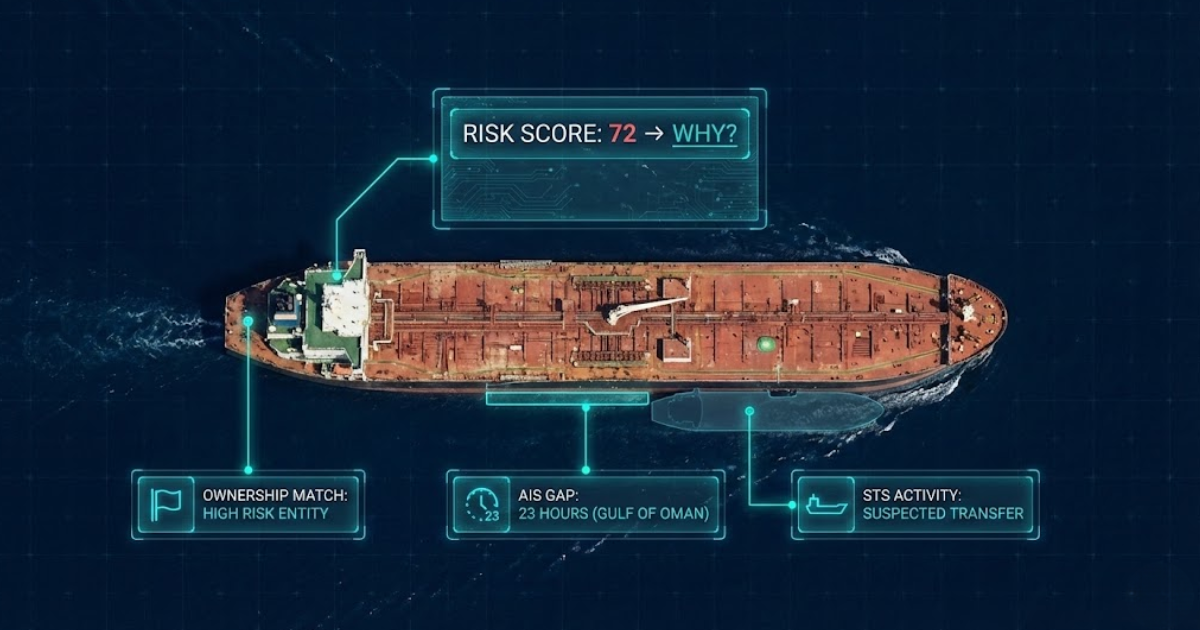
Traditional sanctions screening systems produce a binary hit/no-hit or an opaque risk score. Explainable AI upgrades that output by providing structured reasons, e.g., “Beneficial owner name ≈ OFAC 92% match; AIS dark period of 14 days during suspected STS; recent IMO number change.” Good explanations combine (1) what matched, (2) why it matters (context), and (3) confidence. That three-part answer is what auditors and banks need to accept to clear a counterparty.
XAI tools commonly used in financial compliance (SHAP, LIME, and related techniques) can show which features drive a model’s score at the transaction, entity, or voyage level, enabling both local (this decision) and global (model behaviour) transparency. These are proven, well-established methods for rendering ML outputs interpretable.
What an explainable screening workflow looks like
Below is a practical, operator-friendly decision spine to embed inside a VMS/chartering platform:
-
Data enrichment & multi-source screening
Pull lists (OFAC, EU, UK, UN), vessel registries, ownership graphs, AIS/telemetry, port call histories and P&I/insurance watchlists. Use fingerprinting to detect IMO/name/flag changes. (Source consolidation reduces false negatives.)
-
Automated scoring + XAI rationale
The model scores a vessel or counterparty and returns an explanation: top contributing features, supporting evidence (snapshot of matched list entries, AIS timeline) and a confidence band.
-
Human-in-the-loop review
Present the XAI output to the chartering or compliance user in a single pane: reason codes (e.g., OwnershipMatch, AISGap, STSHistory), confidence, recommended action (Block / Escalate / Approve) and one-click evidence attachments.
-
Decision logging & audit trail
Record full inputs, the XAI explanation, the final decision, reviewer identity, timestamp and any override justification. This audit artefact is essential for regulators and banks.
-
Feedback loop
Capture reviewer corrections (false positive/negative) to retrain the model and reduce noise over time.
Design patterns that a VMS UI should show
-
Evidence snapshot: small cards showing matched sanctions list entry, ownership graph match, AIS map overlay (with timestamps).
-
Explainability panel: ranked feature contributions (e.g., SHAP values) with plain-language translation (“Owner name similarity drove 60% of score”).
-
Confidence & provenance: show data source and last refresh time for each evidence piece.
-
One-click actions: Escalate to legal, Request enhanced due diligence, or Clear & document.
These UI elements convert model outputs into operational actions and make the decision defensible to auditors.
Governance, model risk and regulatory fit
Explainability is only half the journey; model governance completes it. A shipping compliance XAI programme needs:
-
Documented model specs (purpose, limitations, data lineage).
-
Versioned training data & performance logs (to show non-discriminatory behaviour and stability).
-
Periodic back-testing (measure false positive trends and adverse impacts).
-
Access controls & approval flows (who can override and why).
These measures also align with growing regulatory expectations: the EU AI Act (and financial regulators) require transparency, technical documentation and human oversight for higher-risk AI systems - all relevant to sanctions screening. Firms using XAI in compliance should prepare technical documentation and explainability artifacts for audits.
Common pitfalls and how to avoid them
-
Over-reliance on a single data source. Counterparty deception often exploits gaps between lists - use ownership graphs and AIS analytics.
-
Explanations that are technical but not actionable. Translate model contributions into business language (e.g., “Ownership match - high risk”) so charterers can make decisions.
-
No feedback loop. Without operator input, models don’t learn what is noise for your trading lanes. Capture overrides and retrain.
-
No provenance or stale data. Make it obvious when a source was last refreshed - stale lists + AIS gaps are a compliance risk.
KPIs & metrics to run the programme by
-
Time-to-clear (%) for positive matches (how quickly genuine positives are escalated).
-
False positive rate (and reduction over time).
-
Override justification completeness (percent of overrides with documented reason).
-
Data freshness (time since last refresh for each data source).
-
Model stability (performance drift; back-test loss).
Example: a short operator script to use XAI outputs
When a vessel is flagged:
-
Open the XAI panel. Read the top 3 reasons.
-
If “OwnershipMatch” is top reason, open the ownership graph and inspect beneficial owners.
-
If “AISGap/STSTransfer” appears, view the AIS timeline & satellite imagery overlay.
-
Decide: Clear (attach rationale), Escalate (legal), or Block (freeze payments/fixtures).
Always save the explanation snapshot - this is your audit file.
Explainability turns compliance into a competitive advantage
Sanctions screening is no longer a checkbox: it’s a competitive operational capability. Explainable AI lets operators achieve three critical outcomes simultaneously: speed (fewer false alarms), safety (higher detection of real risks), and defensibility (auditable explanations for every decision). For chartering desks and compliance teams, XAI is not a luxury - it’s the tool that turns an opaque risk process into an auditable, trustable business control

-1.png) Alex
Alex
-1.png?width=30&name=Untitled%20design%20(98)-1.png) Alex: Jun 19, 2026
Alex: Jun 19, 2026