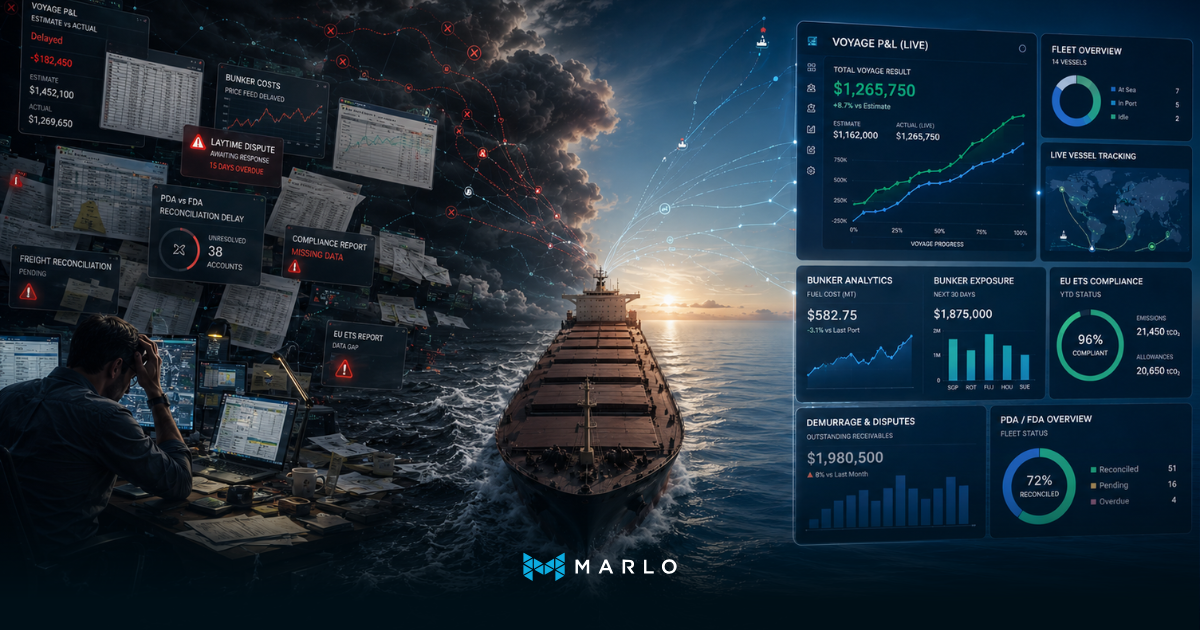
Covenant Breaches Discovered After the Fact
It's Thursday morning. Your quarterly covenant compliance certificates are due to lenders by Friday. Your finance manager has spent the past three days pulling data from multiple systems, calculating DSCR, LTV, minimum liquidity, and tangible net worth ratios.
At 4 PM Thursday, she walks into your office with bad news.
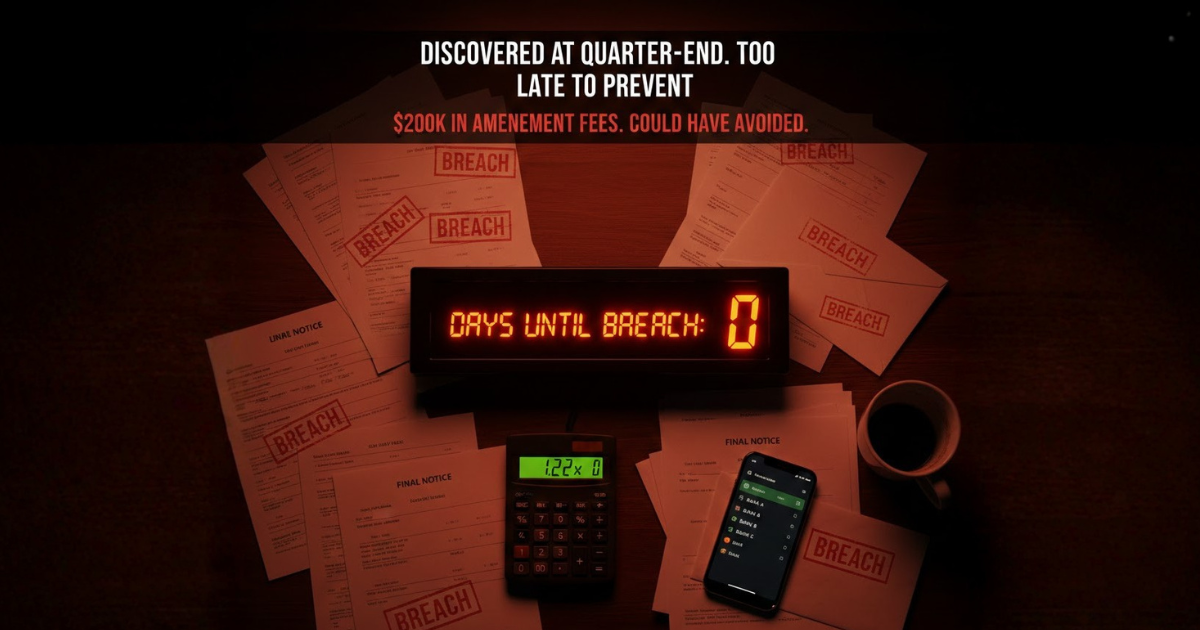
"We breached the DSCR covenant. We were at 1.18x. The requirement is 1.25x."
Your stomach drops. The breach happened sometime in the past 90 days, but you're discovering it now—at quarter-end—with zero time to prevent it.
What happens next:
- Immediate technical default - You're in breach of your loan agreement
-
- Lender notification - You must report the breach immediately (contractual requirement)
-
- Cross-default risk - Breach in one facility can trigger defaults across all your loans
-
- Waiver/amendment process - Emergency negotiations with lenders
-
- Amendment fees - $50,000-$200,000+ per facility for covenant relief
-
- Legal costs - $25,000-$75,000 for counsel on both sides
-
- Relationship damage - Lenders lose confidence in your financial management
Total cost of one missed covenant: $100,000-$300,000+ in hard costs, plus reputational damage that affects future financing terms.
The worst part? The breach was preventable. If you'd known six weeks earlier that DSCR was trending toward 1.20x, you could have:
- Deferred non-critical capex
-
- Accelerated receivables collection
-
- Drawn on working capital facility
-
- Proactively discussed amendment with lender before breach
-
But you didn't know. Because covenant monitoring was a quarterly ritual, not a continuous process.
This is the maritime CFO's covenant nightmare. And it's more common than the industry admits.
Why Manual Covenant Monitoring Fails Maritime CFOs
The Quarterly Panic Cycle
Here's how most maritime finance teams monitor loan covenants:
Month 1-2 of quarter: Business as usual, no covenant focus
Month 3, Week 1-2: Begin gathering data for covenant calculations
- Pull vessel valuations from brokers
-
- Extract financial data from accounting system
-
- Compile debt schedules from multiple loan agreements
-
- Calculate EBITDA, cash balances, working capital
-
-
Month 3, Week 3: Intensive covenant calculation work
- Build Excel models for each covenant type
-
- Calculate DSCR (Debt Service Coverage Ratio)
-
- Calculate LTV (Loan-to-Value) using vessel valuations
-
- Verify minimum liquidity and cash requirements
-
- Check tangible net worth calculations
-
- Cross-check leverage ratios
-
-
Month 3, Week 4: Review, corrections, certificate preparation
- CFO reviews calculations
-
- Errors discovered (formula mistakes, outdated data)
-
- Recalculations required
-
- Compliance certificates prepared and signed
-
- Submitted to lenders (often days late)
-
Problem: By the time you discover a covenant issue, the quarter is over. You have zero runway to prevent the breach.
The Multi-Lender Complexity Nightmare
Typical maritime operator reality:
- 5-10 different lending facilities
-
- Each lender has unique covenant package
-
- Different calculation methodologies
-
- Different testing frequencies (monthly, quarterly, annual)
-
- Different definitions of the same ratios
-
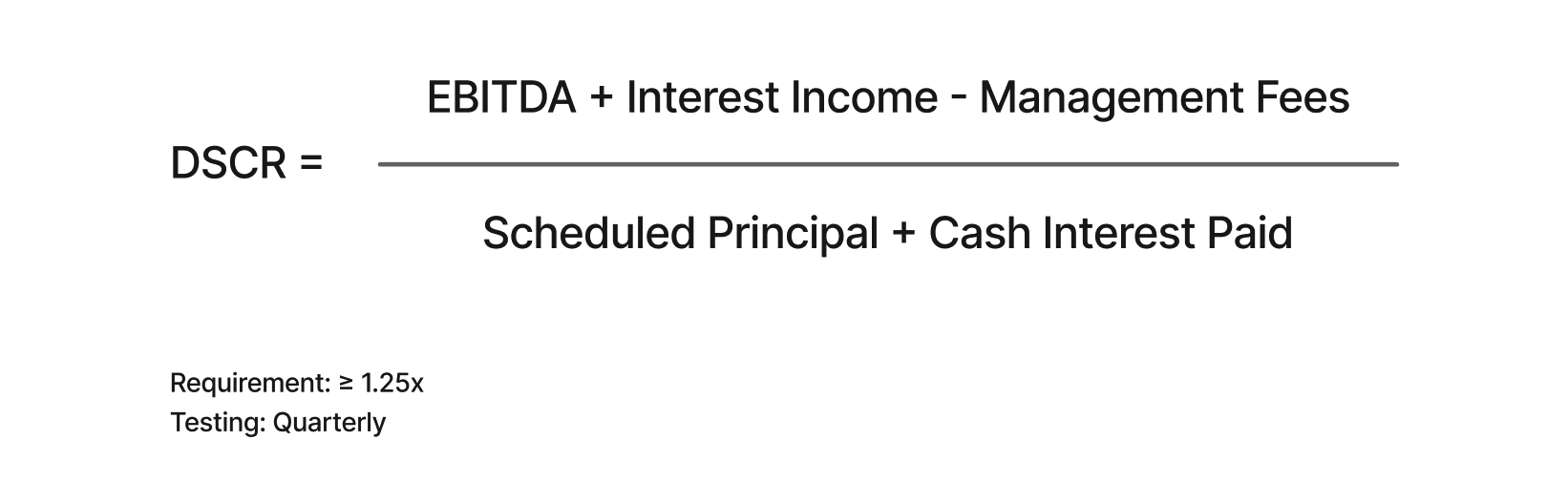
Example: Three lenders, three different DSCR definitions
Lender A (Senior Secured):
Lender B (Mezzanine):
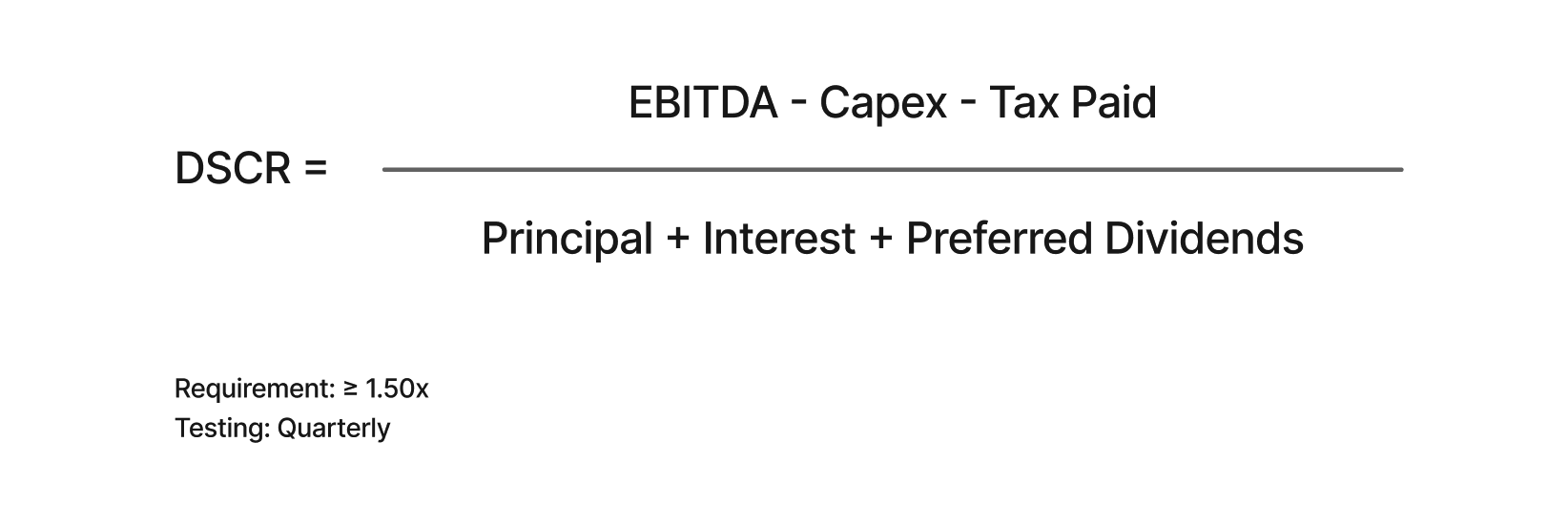
Lender C (Working Capital Facility):
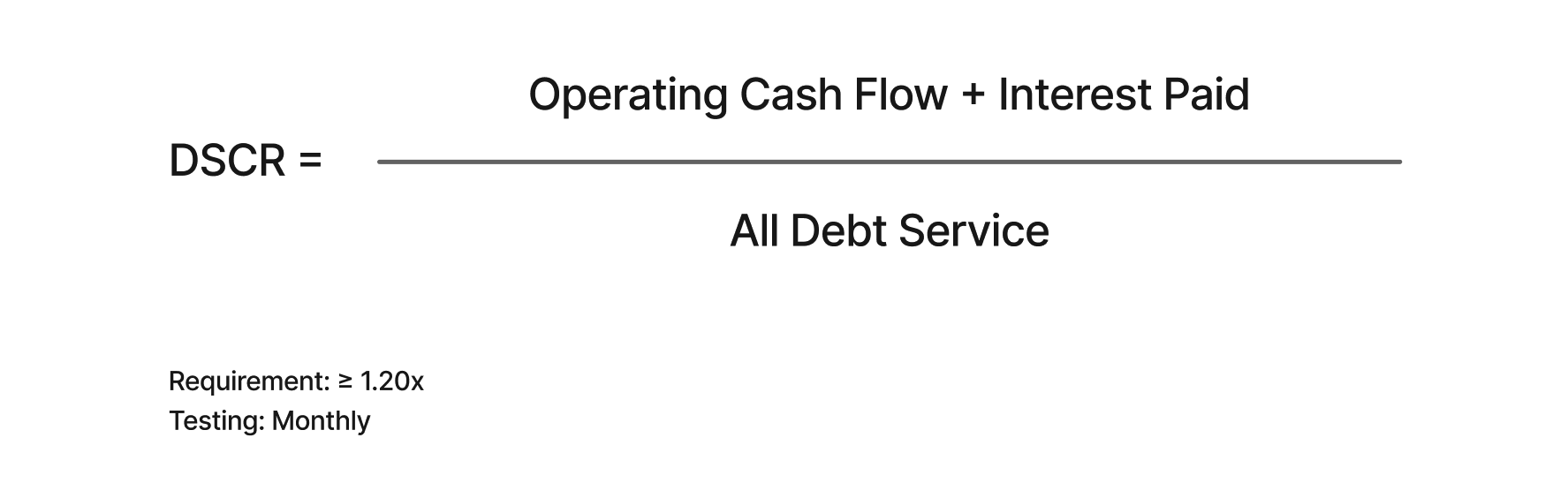
Same covenant name. Three completely different calculations.
Your finance manager maintains three separate Excel models, each with different inputs, formulas, and testing schedules. One formula error = potential breach.
The Vessel Valuation Headache
Maritime-specific covenant challenge: LTV calculations require current vessel market valuations.
The problem:
- Vessel values fluctuate with market conditions
-
- Valuations from brokers arrive weeks after quarter-end
-
- By the time you get valuations, you may have already breached
-
- No way to know LTV position in real-time
-
Real example:
- Q3 ends September 30
-
- Vessel valuations requested October 5
-
- Broker valuations received October 18
-
- LTV calculation shows 76% (requirement: ≤75%)
-
- Breach occurred in September, discovered mid-October
-
The CFO dilemma: Do you order valuations monthly (expensive) or quarterly (risk delayed breach discovery)?
Most choose quarterly, accepting the risk of late discovery.
The Cross-Default Domino Effect
The scariest part of covenant breaches: Cross-default clauses.
How cross-default works:
- You have 8 different loan facilities from 6 lenders
-
- Each facility has "cross-default" provision
-
- Breach in ANY facility triggers technical default in ALL facilities
-
- One covenant miss = 8 simultaneous defaults
-
Cascade scenario:
- You breach DSCR in Facility A (Bank 1)
-
- Cross-default clause triggers in Facilities B, C, D (Bank 2, Bank 3)
-
- Cross-default triggers in Facilities E, F, G, H (Bank 4, Bank 5, Bank 6)
-
- All lenders must be notified immediately
-
- Each lender requires separate waiver/amendment
-
- Total amendment fees: $400K-$1.5M across all facilities
One missed covenant in one facility can cost you seven figures in amendment fees.
This is why covenant monitoring isn't just important—it's existential for maritime CFOs.
The Agitation: Why This Problem Gets Worse
Fleet Growth Multiplies Covenant Complexity
Small operator (5 vessels):
- 2-3 loan facilities
-
- 5-8 covenants to monitor
-
- 1 finance person handles covenant tracking
-
- Quarterly monitoring feasible
-
Mid-size operator (20 vessels):
- 6-8 loan facilities
-
- 15-25 covenants to monitor
-
- Different vessels in different SPVs
-
- Multiple lenders, multiple covenant packages
-
- Finance manager spends 40+ hours/quarter on covenant compliance
-
Large operator (50+ vessels):
- 15+ loan facilities
-
- 40-60 covenants to monitor
-
- Complex SPV structures with intercompany guarantees
-
- Different covenants for different vessel classes
-
- Dedicated covenant compliance person required
-
- 80-120 hours/quarter just on monitoring
-
The scaling problem: Covenant work doesn't scale linearly—it scales exponentially.
Market Volatility Creates Constant Covenant Pressure
Shipping markets are cyclical and volatile:
Scenario 1: Dry bulk downturn
- Freight rates drop 40% in 6 months
-
- TCE earnings fall below breakeven
-
- EBITDA declines
-
- DSCR covenants come under pressure
-
- But you don't know you're approaching breach until quarter-end calculation
-
Scenario 2: Vessel value decline
- Secondhand vessel values drop 20% due to market correction
-
- Your LTV ratio increases from 68% to 82%
-
- LTV covenant requirement: 75%
-
- Breach discovered when quarterly valuations arrive
-
Scenario 3: Bunker cost spike
- Fuel costs increase 50% due to geopolitical events
-
- Voyage margins compress
-
- Operating cash flow declines
-
- Interest coverage ratio deteriorates
-
- Monthly DSCR covenant at risk, but no visibility until calculation
-
The problem: Market volatility creates continuous covenant risk, but quarterly monitoring gives you only four snapshots per year.
What you need: Real-time monitoring that alerts you when covenants trend toward breach, giving you weeks to respond instead of discovering after the fact.
The Covenant Amendment Cost Spiral
First breach is expensive. Second breach is catastrophic.
First covenant breach:
- Lenders willing to grant waiver/amendment
-
- Standard amendment fees: $50K-$100K per facility
-
- Some goodwill remains
-
- Future monitoring scrutiny increases
-
-
Second breach (within 12-18 months):
- Lenders question management competence
-
- Amendment fees increase: $100K-$200K per facility
-
- Additional restrictions imposed (cash sweeps, higher margins)
-
- Some lenders may refuse to amend
-
- Refinancing becomes necessary (expensive, time-consuming)
-
-
Third breach:
- Lenders lose confidence completely
-
- Forced asset sales to repay debt
-
- Refinancing with worse terms (higher rates, tighter covenants)
-
- Equity dilution to bring in rescue capital
-
- Potential loss of CFO position
-
The downward spiral: Once you breach once, the pressure intensifies. Tighter scrutiny, less flexibility, higher costs. Preventing the first breach is critical.
The Manual Error Risk
Covenant calculations are complex. Manual Excel models introduce error risk.
Common calculation errors:
- Using wrong data period (TTM vs. quarterly)
-
- Incorrect EBITDA adjustments (one-time items)
-
- Outdated vessel valuations in LTV calculations
-
- Wrong currency conversions for multi-currency debt
-
- Formula errors in Excel (reference mistakes)
-
- Using preliminary financials instead of final audited numbers
-
Real consequence: You report compliance when you're actually in breach (or vice versa).
Scenario:
- Finance manager calculates DSCR at 1.26x (above 1.25x requirement)
-
- Submits compliance certificate to lenders
-
- External auditor reviews, finds formula error
-
- Actual DSCR was 1.22x
-
- Now you've misrepresented compliance to lenders—potentially a default event itself
-
The irony: The manual process designed to ensure compliance creates compliance risk through human error.
The Solution: Automated Real-Time Covenant Monitoring
What Real-Time Covenant Monitoring Actually Means
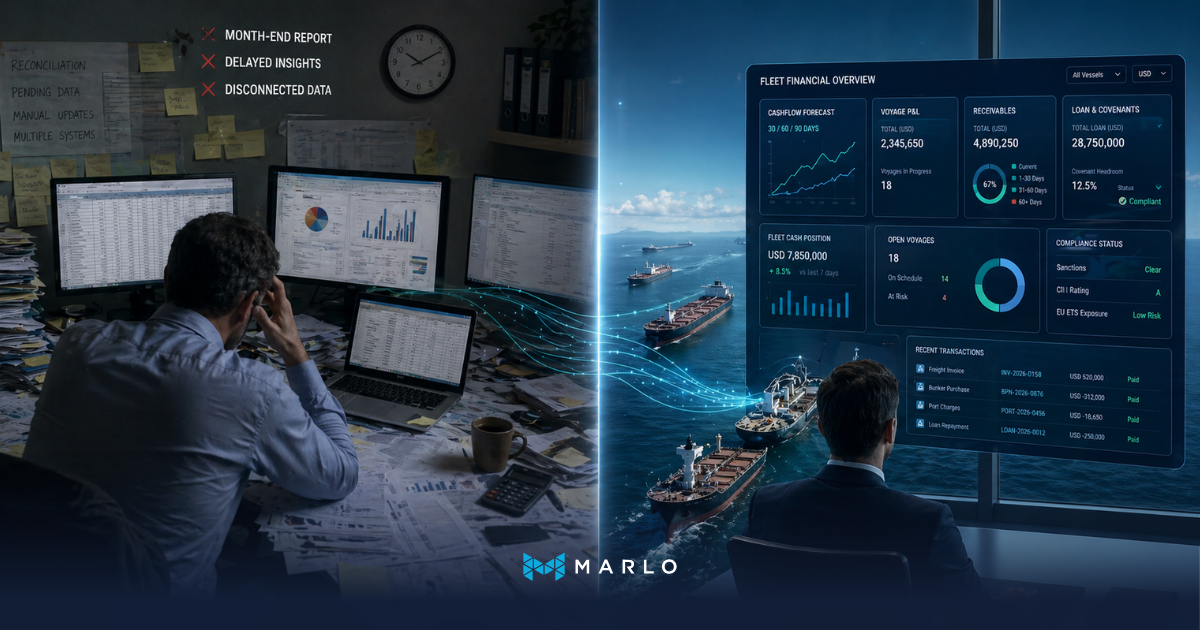
Traditional approach (manual quarterly):

Automated approach (real-time monitoring):

The fundamental difference: Shifting from reactive breach discovery to proactive breach prevention.
How Automated Covenant Monitoring Works
1. Live Data Integration
Instead of manually pulling data quarterly, covenant monitoring system connects directly to:
- Accounting system - Real-time EBITDA, cash balances, working capital
-
- Loan management system - Debt schedules, payment tracking, principal/interest
-
- Vessel valuation sources - Automated valuation updates (monthly or on-demand)
-
- Banking systems - Live cash positions, FX rates
-
Result: Covenant calculations update automatically as financial data changes—daily, weekly, or even hourly.
2. Multi-Lender Covenant Library
Pre-configured covenant definitions for each lender:
- Lender A: DSCR calculation method, 1.25x threshold, quarterly testing
-
- Lender B: Different DSCR method, 1.50x threshold, quarterly testing
-
- Lender C: LTV calculation, 75% maximum, monthly with vessel valuations
-
- Lender D: Minimum liquidity, $500K per vessel, tested daily
-
Each covenant auto-calculates using correct methodology.
No manual Excel modeling. No formula errors. No using wrong data period.
3. Early Warning Alert System
Traditional: Discover breach at quarter-end (0 days to respond)
Automated system alerts:
- Green zone (>10% cushion): No alerts, comfortable compliance
-
- Yellow zone (5-10% cushion): "Attention: DSCR trending toward threshold"
-
- Orange zone (0-5% cushion): "Warning: Covenant breach possible next quarter"
-
- Red zone (breach): "URGENT: Covenant breach detected"
-
Example scenario:
Week 1 of Quarter:
- DSCR: 1.35x (requirement: 1.25x)
-
- Status: Green
-
- Cushion: 8% above requirement
-
Week 6 of Quarter:
- DSCR: 1.28x (trending down due to lower freight rates)
-
- Status: Yellow
-
- Alert: "DSCR declined from 1.35x to 1.28x in past 5 weeks. Monitor closely."
-
Week 10 of Quarter:
- DSCR: 1.23x (projected based on current trajectory)
-
- Status: Orange
-
- Alert: "WARNING: DSCR projected to breach 1.25x requirement by quarter-end. Current: 1.26x. Recommend immediate action."
-
CFO response options (with 3+ weeks remaining):
- Defer planned drydocking (reduces Q3 capex, improves EBITDA)
-
- Accelerate charter payment collection (improves cash EBITDA)
-
- Draw working capital facility to increase liquidity
-
- Contact lender proactively to discuss temporary relief
Result: Breach prevented through early intervention.
Without automated monitoring: Discover 1.23x DSCR at quarter-end, too late to prevent breach, $150K amendment fee.
Multi-Covenant Dashboard: See Everything at Once
Instead of checking covenants one at a time, CFO sees unified view:
Covenant Compliance Dashboard - Q3 2026
| Covenant |
Lender |
Current |
Requirement |
Status |
Trend |
| DSCR |
Bank A |
1.26x |
≥1.25x |
🟡 Warning |
↓ Declining |
| LTV |
Bank A |
71% |
≤75% |
🟢 Safe |
→ Stable |
| Min Liquidity |
Bank A |
$8.2M |
≥$7.5M |
🟢 Safe |
↑ Improving |
| DSCR |
Bank B |
1.52x |
≥1.50x |
🟡 Warning |
↓ Declining |
| Interest Coverage |
Bank B |
2.8x |
≥2.5x |
🟢 Safe |
→ Stable |
| Max Leverage |
Bank C |
68% |
≤70% |
🟡 Warning |
↑ Worsening |
| TNW |
Bank C |
$62M |
≥$50M |
🟢 Safe |
↑ Improving |
| Current Ratio |
Bank D |
1.15x |
≥1.10x |
🟡 Warning |
↓ Declining |
At-a-glance insights:
- 3 covenants in yellow warning zone (need attention)
-
- 5 covenants in green safe zone
-
- 0 covenants in breach
-
- Trend arrows show direction of movement
-
CFO action: Focus on the three warning-zone covenants, understand drivers, take preventive action.
This visibility simply doesn't exist with manual quarterly monitoring.
Scenario Modeling: Test Before You Act
Powerful capability: Model "what-if" scenarios before making decisions.
Example: Vessel acquisition decision
You're considering buying a 10-year-old Panamax for $28M with $21M debt financing.
Questions:
- How does this impact our consolidated DSCR?
-
- Will we breach our maximum leverage covenant?
-
- Does this affect our minimum liquidity requirement?
-
Traditional approach: Build complex Excel model, make assumptions, calculate manually, hope you got it right.
Automated approach: Enter acquisition parameters into system, instantly see covenant impact:
Scenario: Acquire Panamax "Ocean Star"
- Purchase price: $28M
-
- Debt financing: $21M @ 5.5% (75% LTV)
-
- Annual P&I payment: $2.8M
-
Projected Covenant Impact:
| Covenant |
Current |
After Acquisition |
Requirement |
Status |
| Consolidated DSCR |
1.35x |
1.28x |
≥1.25x |
🟡 Reduced but OK |
| Fleet LTV |
68% |
70% |
≤75% |
🟢 Still compliant |
| Min Liquidity |
$10M |
$7M |
≥$7.5M |
🔴 BREACH |
| Max Leverage |
65% |
69% |
≤70% |
🟢 Still compliant |
Result: Acquisition would breach minimum liquidity covenant.
CFO decision: Either:
- Don't acquire vessel
-
- Negotiate lower purchase price
-
- Use less debt financing
-
- Arrange bridge facility to meet liquidity requirement
-
- Proactively discuss covenant amendment with lender before acquisition
Without scenario modeling: You acquire the vessel, discover liquidity breach at quarter-end, pay $100K amendment fee, damage lender relationship.
One-Click Compliance Certificate Generation
The old way (3-5 hours per lender, per quarter):
- Pull covenant calculation Excel file
-
- Update with latest financial data
-
- Recalculate all formulas
-
- Prepare compliance certificate Word document
-
- CFO reviews calculations
-
- Find errors, recalculate
-
- Final review
-
- Sign and submit
Multiply by 6-8 lenders = 20-40 hours quarterly
The automated way (5 minutes per lender, per quarter):
- Click "Generate Compliance Certificate - Bank A Q3 2026"
-
- System auto-populates all covenant calculations with latest data
-
- CFO reviews pre-filled certificate
-
- Click "Approve and Send"
-
- System emails PDF to lender contact
Multiply by 6-8 lenders = 30-45 minutes quarterly
Time savings: 95%+
Accuracy improvement: Calculations pulled directly from source systems, no manual data entry errors.
Timeliness: Certificates can be generated day-after quarter-end instead of 10-15 days later.
Real-World Impact: What Changes for Maritime CFOs
From Quarterly Panic to Daily Confidence
Before automated monitoring:
- Covenant awareness: 4 times per year (quarter-ends)
-
- Breach discovery: After the fact, zero prevention runway
-
- CFO stress level: Extreme during covenant season, anxiety between quarters
-
- Team workload: Concentrated in 2-week quarterly sprints
-
- Lender relationship: Reactive, defensive during breach discussions
-
After automated monitoring:
- Covenant awareness: Continuous, daily dashboard review
-
- Breach discovery: 6-8 weeks early warning, ample prevention time
-
- CFO stress level: Significantly reduced, proactive control
-
- Team workload: Light ongoing monitoring vs. quarterly panic
-
- Lender relationship: Proactive, partnership-oriented
-
The psychological shift: From dreading covenant season to confidently managing covenant position year-round.
Preventing the $200K Mistake
Real scenario (composite from multiple maritime CFOs):
Company: 18-vessel dry bulk operator, $450M fleet value, $310M total debt
Situation: Dry bulk market softens, freight rates down 35% vs. prior year
Q2 covenant testing (traditional manual approach):
- Finance team calculates covenants in final week of Q2
-
- DSCR result: 1.22x (requirement: 1.25x)
-
- Breach discovered after quarter already closed
-
Immediate response:
- Emergency board meeting to discuss breach
-
- Notify all lenders (cross-default triggers across 7 facilities)
-
- Engage restructuring counsel ($50K retainer)
-
- Begin amendment negotiations
-
Amendment costs:
- Bank A (senior lender): $125K amendment fee
-
- Bank B (mezzanine): $75K amendment fee
-
- Bank C-E (smaller facilities): $50K combined
-
- Legal fees: $60K
-
- Total cost: $310K
-
Plus non-monetary costs:
- CFO spends 80+ hours managing breach/amendment process
-
- Lenders impose tighter monitoring (monthly reporting)
-
- Margin increase: +50bps on $310M = $1.55M additional annual interest
-
- Reputation damage affecting future financing
-
What if they had automated monitoring?
Week 8 of Q2 (4 weeks before quarter-end):
- System alerts: "DSCR projected 1.23x by quarter-end (requirement 1.25x)"
-
- CFO reviews drivers: Lower freight rates, higher bunker costs
-
CFO actions (with 4 weeks to respond):
- Defer planned $2.5M drydocking to Q3 (improves Q2 EBITDA)
-
- Accelerate $1.8M in charter receivables (improve Q2 cash)
-
- Reduce crew overtime and discretionary spending
-
- Contact Bank A (relationship lender) to discuss potential relief if actions insufficient
Result:
- Deferred drydocking: +$2.5M EBITDA improvement
-
- Accelerated collections: +$1.8M cash EBITDA
-
- Reduced expenses: +$0.3M
-
- Q2 DSCR: 1.27x (above 1.25x requirement)
-
Breach avoided.
Cost savings:
- Amendment fees avoided: $250K
-
- Legal fees avoided: $60K
-
- Margin increase avoided: $1.55M/year
-
- Total benefit: $310K immediate + $1.55M annual
-
ROI on automated covenant monitoring: Pays for itself 10-15x over with one prevented breach.
Strengthening Lender Relationships
Lenders evaluate borrowers on two dimensions:
- Financial performance (can you pay us back?)
-
- Management competence (do you know what you're doing?)
Manual covenant monitoring signals:
- Late compliance certificates (submitted 10-15 days after deadline)
-
- Calculation errors requiring corrections
-
- Surprised by covenant breaches
-
- Reactive communication ("we have a problem")
-
Lender perception: "Management doesn't have strong financial controls."
Automated covenant monitoring signals:
- Early compliance certificates (submitted 1-3 days after quarter-end)
-
- Clean, accurate calculations
-
- Proactive covenant management
-
- Forward-looking communication ("covenant trending close, here's our plan")
-
Lender perception: "Management has excellent financial controls and visibility."
Real-world impact:
Scenario 1 - Refinancing:Your facility matures, you need to refinance $150M.
Strong lender relationship:
- Clean covenant history
-
- Proactive communication
-
- Lenders compete for your business
-
- Better pricing (20-30bps lower margin)
-
- Savings: $300K-$450K annually
-
Weak lender relationship:
- Covenant breach history
-
- Late/sloppy reporting
-
- Lenders cautious
-
- Higher pricing to compensate for perceived risk
-
- Cost: $300K-$450K higher annually
-
Scenario 2 - Market downturn:Freight market drops, you need temporary covenant relief.
Strong relationship:
- Lender trusts your management
-
- Quick amendment (4-6 weeks)
-
- Reasonable fees ($25K-$50K)
-
- Maintains existing margin
-
Weak relationship:
- Lender skeptical of projections
-
- Extended negotiations (8-12 weeks)
-
- High fees ($100K-$150K)
-
- Margin increase (+25-50bps)
-
The meta-point: Automated covenant monitoring isn't just about preventing breaches—it's about demonstrating financial competence that translates to better lending terms over the long run.
Enabling Strategic Growth Decisions
Without real-time covenant visibility, acquisition decisions are risky:
Traditional approach:
- Commercial team identifies acquisition opportunity
-
- Preliminary financial analysis shows good returns
-
- Board approves, begin negotiations
-
- Only then does CFO model covenant impact
-
- Discover acquisition would breach covenants
-
- Either abort deal (wasted time/money) or scramble for amendment
With automated covenant monitoring:
- Commercial team identifies acquisition opportunity
-
- CFO runs covenant scenario analysis immediately
-
- Knows within minutes whether covenants allow acquisition
-
- If problematic, either:
-
- Adjust acquisition structure (less debt, more equity)
-
- Proactively approach lenders for pre-approval
-
- Pass on deal before wasting resources
Result: Faster, smarter acquisition decisions.
Real example:
- Opportunity: Acquire 5-vessel package from distressed seller
-
- Price: $110M (attractive valuation)
-
- Available financing: $82.5M debt (75% LTV)
-
Covenant scenario analysis (5 minutes):
- Fleet LTV increases from 68% to 74% (still under 75% limit) ✓
-
- Consolidated DSCR decreases from 1.42x to 1.31x (still above 1.25x) ✓
-
- Minimum liquidity: $9.2M after acquisition (requirement: $10M) ✗
-
Issue identified: $800K short on minimum liquidity requirement.
CFO solutions (evaluated in real-time):
- Use less debt, more equity ($75M debt + $35M equity) → Liquidity OK but returns lower
-
- Negotiate $5M working capital increase with Bank A → Maintains returns, adds $50K annual fee
-
- Acquire 4 vessels instead of 5 → Stays compliant, lower strategic impact
Board decision: Pursue option 2, contact Bank A for WC increase before finalizing acquisition.
Outcome: Deal closes without covenant issues. Working capital facility approved in 3 weeks.
Without covenant monitoring: Would have discovered liquidity breach at Q3-end, 60 days after acquisition closed, requiring expensive emergency amendment.
Implementation: What Maritime CFOs Need to Know
Standalone vs. Integrated Covenant Monitoring
Option 1: Standalone covenant monitoring tool
- Pros: Focused functionality, potentially lower cost
-
- Cons: Requires data feeds from accounting, VMS, banking systems; another system to maintain
-
Option 2: Integrated maritime ERP with covenant monitoring
- Pros: Single platform, real-time data flow, no integration work
-
- Cons: Requires broader system change (but delivers additional benefits)
-
CFO recommendation: If you're already planning to modernize maritime finance systems, integrated approach delivers greater value.
If covenant monitoring is urgent priority: Standalone tool can be implemented faster (4-6 weeks) vs. full ERP migration (8-12 weeks).
Data Requirements for Effective Monitoring
To automate covenant monitoring, you need clean, accessible:
- Financial data:
- Monthly P&L, balance sheet, cash flow
-
- EBITDA with consistent calculation methodology
-
- Working capital components
-
- Debt schedules (principal, interest, payment dates)
-
- Vessel data:
- Fleet list with current market valuations
-
- Valuation update frequency (monthly, quarterly)
-
- Vessel classification (owned, bareboat chartered, etc.)
-
- Loan documentation:
- All loan agreements with covenant definitions
-
- Testing frequencies (monthly, quarterly, annual)
-
- Notice requirements and cure periods
-
- Lender contact information
Data quality matters: Automated monitoring is only as good as input data. Plan for data cleanup period during implementation.
Implementation Timeline
Typical 6-8 week implementation for mid-sized fleet:
Weeks 1-2: Setup and configuration
- Compile all loan agreements and covenant definitions
-
- Configure covenant library (calculation methods, thresholds)
-
- Set up data connections (accounting, vessel valuations)
-
- Define alert thresholds and recipients
-
Weeks 3-4: Historical data and testing
- Load historical financial data (past 8-12 quarters)
-
- Validate calculations against manual Excel models
-
- Identify and fix any calculation discrepancies
-
- User training on dashboard and alert system
-
Weeks 5-6: Parallel running
- Continue manual covenant calculations for compliance
-
- Compare automated results to manual calculations
-
- Build confidence in system accuracy
-
- Refine alert logic based on user feedback
-
Weeks 7-8: Go-live and transition
- Cutover to automated monitoring as primary method
-
- Generate first compliance certificates from system
-
- Maintain manual backup for one more quarter
-
- Full adoption and manual process retirement
-
Post-implementation: Ongoing quarterly refinement as you discover additional optimization opportunities.
Change Management Considerations
Finance team reactions:
Concern 1: "I've spent 10 years building these Excel models. Now they're obsolete?"Response: Your expertise isn't in the Excel formulas—it's in understanding covenant mechanics and lender relationships. Automation frees you for strategic work.
Concern 2: "What if the system makes a mistake?"Response: That's why we parallel-run. You verify system accuracy before trusting it. Plus, automated calculations are more consistent than manual Excel (no formula errors).
Concern 3: "I'll lose control/visibility."Response: Actually you gain visibility. Real-time dashboards show covenant position daily, not just quarterly. You have more control, not less.
CFO leadership approach:
- Involve finance team in system selection and configuration
-
- Emphasize time savings, not headcount reduction
-
- Redeploy saved time to strategic projects (cash forecasting, scenario planning)
-
- Celebrate early wins (first automated compliance certificate, first prevented breach)
Selecting the Right Solution
Evaluation criteria for covenant monitoring systems:
1. Maritime-specific capabilities
- Pre-built covenant definitions for common maritime loan structures
-
- LTV calculations with vessel valuation integration
-
- Pool financing and SPV structure support
-
- Understanding of maritime cash flow patterns
-
2. Flexibility and configurability
- Ability to handle custom covenant definitions
-
- Support for multiple calculation methodologies
-
- Configurable alert thresholds
-
- Custom reporting for different lender requirements
-
3. Integration capabilities
- Direct connections to accounting systems
-
- Vessel valuation data feeds
-
- Banking system integration
-
- API access for future integrations
-
4. User experience
- Intuitive dashboard for CFO-level oversight
-
- Detailed drill-down for finance team investigations
-
- Mobile access for on-the-go monitoring
-
- Automated reporting and certificate generation
-
5. Audit trail and compliance
- Complete calculation history
-
- Version control on covenant definitions
-
- User activity logging
-
- SOC 2 compliance for data security
-
Ask vendors to demonstrate:
- Handling your specific covenant types
-
- Scenario modeling with your actual fleet
-
- Compliance certificate generation matching your lender format
-
- Alert system with realistic threshold scenarios
-
ROI Analysis: The CFO Business Case
Direct Cost Savings
1. Avoided amendment fees
- Typical breach cost: $150K (average across facilities)
-
- Breach frequency without monitoring: 1 every 18-24 months
-
- Breach frequency with monitoring: 1 every 5+ years (mostly avoided)
-
- Annual savings: $75K-$100K
-
2. Reduced finance team workload
- Current covenant work: 160 hours/year (quarterly cycle)
-
- Automated covenant work: 20 hours/year (review and oversight)
-
- Hours saved: 140 hours/year
-
- Finance manager loaded cost: $150/hour
-
- Annual savings: $21K
-
3. Lower audit fees
- Clean covenant audit trail reduces testing
-
- Estimated audit time reduction: 5-10 hours
-
- Audit partner rate: $500/hour
-
- Annual savings: $2.5K-$5K
-
Total direct savings: $98.5K-$126K annually
Avoided Costs (Contingent Benefits)
4. Prevented cross-default scenarios
- Single breach triggering 7 facilities
-
- Amendment fees: $75K-$150K per facility
-
- Total cross-default cost: $525K-$1.05M
-
- Probability: 20-30% chance over 5 years without monitoring
-
- Expected value of prevention: $105K-$315K over 5-year period
-
- Annualized value: $21K-$63K
-
5. Maintained favorable lender pricing
- Clean covenant history = 15-25bps better pricing on refinancing
-
- Total debt: $200M (typical mid-sized operator)
-
- Annual value: $300K-$500K (over loan lifecycle)
-
6. Faster acquisition execution
- Rapid covenant scenario analysis enables faster decisions
-
- Avoided lost opportunities from late covenant discovery
-
- Estimated value: 1-2 deals over 5 years
-
- Incremental value: Difficult to quantify but significant
-
Strategic Value (Non-Monetary)
7. CFO peace of mind
- Sleep better knowing real-time covenant visibility
-
- Confidence in board presentations ("We're at 1.35x DSCR, well above threshold")
-
- Reduced stress during quarter-ends
-
8. Stronger lender relationships
- Proactive communication
-
- Professional compliance reporting
-
- Preferred status for future financing
-
9. Better capital allocation decisions
- Confidence to pursue growth when covenants allow
-
- Clarity on when to preserve cash vs. invest
-
Total 5-year value: $1.5M-$2.5M for mid-sized operator
Payback Calculation
Investment:
- Implementation: $40K-$60K (including configuration and training)
-
- Annual subscription: $25K-$40K (depending on fleet size and complexity)
-
- Year 1 total cost: $65K-$100K
-
Year 1 benefits:
- Direct savings: $98.5K-$126K
- Avoided breach (50% probability first year): $75K-$150K expected value
Payback period: 4-8 months
5-year TCO comparison:
| Cost Category |
Manual Process |
Automated Monitoring |
Savings |
| Finance team labor |
$105K |
$15K |
$90K |
| Covenant amendments |
$375K (avg 2-3 breaches) |
$75K (1 breach) |
$300K |
| Audit fees |
$25K |
$12.5K |
$12.5K |
| Software/tools |
$0 (Excel) |
$150K (subscription) |
-$150K |
| Total 5-year cost |
$505K |
$252.5K |
$252.5K |
Plus unmeasured benefits: Better lender relationships, faster decisions, CFO confidence.
ROI: 2.5-3.0x over 5 years
Conclusion: Covenant Monitoring is Risk Management
Here's what every maritime CFO knows but few talk about publicly:
Loan covenant breaches aren't rare. They're common, especially during market downturns. The difference between successful maritime CFOs and those who struggle isn't avoiding all covenant pressure—it's managing covenant position proactively instead of reactively.
The old approach—quarterly manual monitoring—made sense 20 years ago when:
- Fleets were smaller (10-15 vessels)
-
- Financing structures were simpler (1-2 lenders)
-
- Covenant packages were standardized
-
-
- Market volatility was lower
-
None of those conditions exist today.
Modern maritime operations face:
- Larger, more complex fleets
-
- Multiple lenders with diverse covenant packages
-
- Increased market volatility (freight rates, vessel values, fuel costs)
-
- Tighter covenants from lenders
-
- Cross-default risk across facilities
-
Quarterly manual monitoring is structurally inadequate for this environment.
The maritime CFOs who thrive in the next decade will:
- Monitor covenants continuously, not quarterly
-
- Prevent breaches through early intervention, not scramble for amendments
-
- Use covenant position to inform strategic decisions
-
- Maintain strong lender relationships through professional compliance
-
- Redeploy finance team time from manual calculations to strategic work
-
This future requires automated covenant monitoring.
The technology exists. The ROI is proven. The implementation is straightforward.
The question isn't whether maritime finance will adopt automated covenant monitoring—it will. The question is whether your company will be an early adopter gaining competitive advantage, or a late adopter learning expensive lessons.
For CFOs reading this: You know the stress of covenant season. You know the cost of covenant amendments. You know the risk of cross-default scenarios.
The solution is available today. The payback period is 6 months. The risk reduction is immediate.
The only question: When do you start?
About Marlo
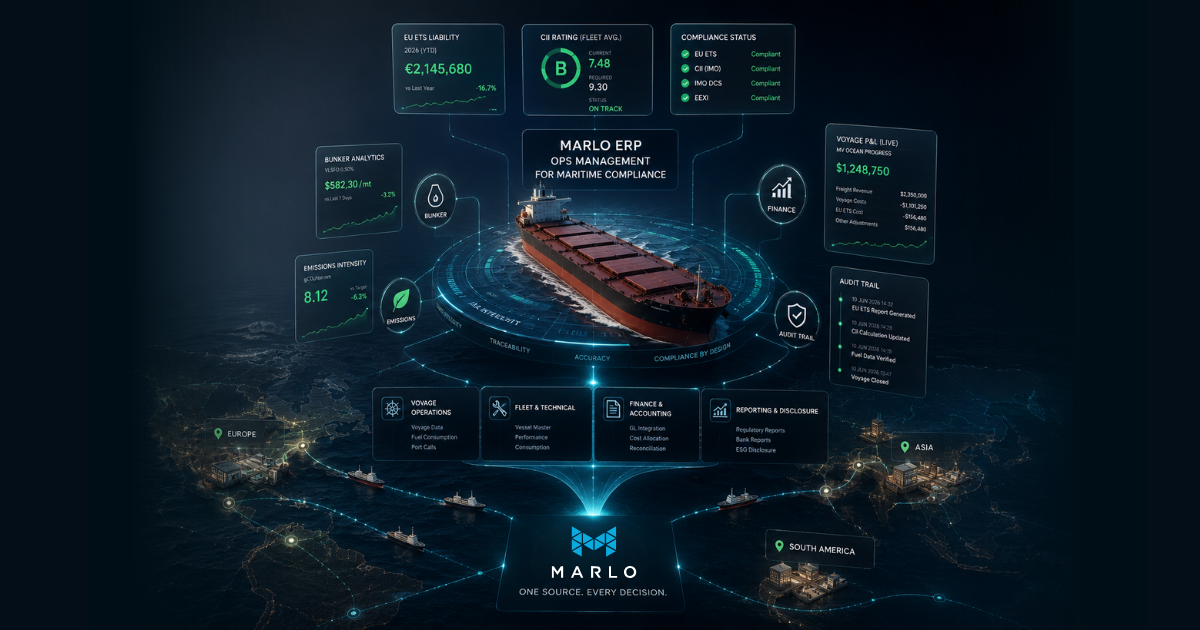
Marlo ( www.marlo.co ) provides integrated maritime ERP with comprehensive loan management and covenant monitoring capabilities purpose-built for ship owners and operators in the dry bulk and tanker sectors.
Covenant Monitoring Features:
- Real-time covenant calculations across all lender facilities
-
- Multi-lender covenant library with flexible calculation definitions
-
- Early warning alert system with 6-8 week breach prevention runway
-
- Scenario modeling for acquisition and strategic decisions
-
- One-click compliance certificates with audit-ready documentation
-
- Vessel valuation integration for automated LTV monitoring
-
- Multi-entity support for SPV structures and complex financing
-
Built for maritime CFOs who need:
- ✅ Continuous covenant visibility instead of quarterly snapshots
-
- ✅ Breach prevention instead of breach response
-
- ✅ Strategic confidence instead of covenant anxiety
-
- ✅ Professional lender relationships instead of reactive crisis management
-
Integrated with Marlo's complete maritime platform:
- Voyage Management for real-time operational data
-
- Finance & Accounting for EBITDA and cash flow calculations
-
- Banking for liquidity and working capital monitoring
-
- Analytics for trend analysis and forecasting
-
Ready to eliminate covenant surprises? Try Marlo for free

-1.png) Alex
Alex
-1.png?width=30&name=Untitled%20design%20(98)-1.png) Alex: Jun 19, 2026
Alex: Jun 19, 2026