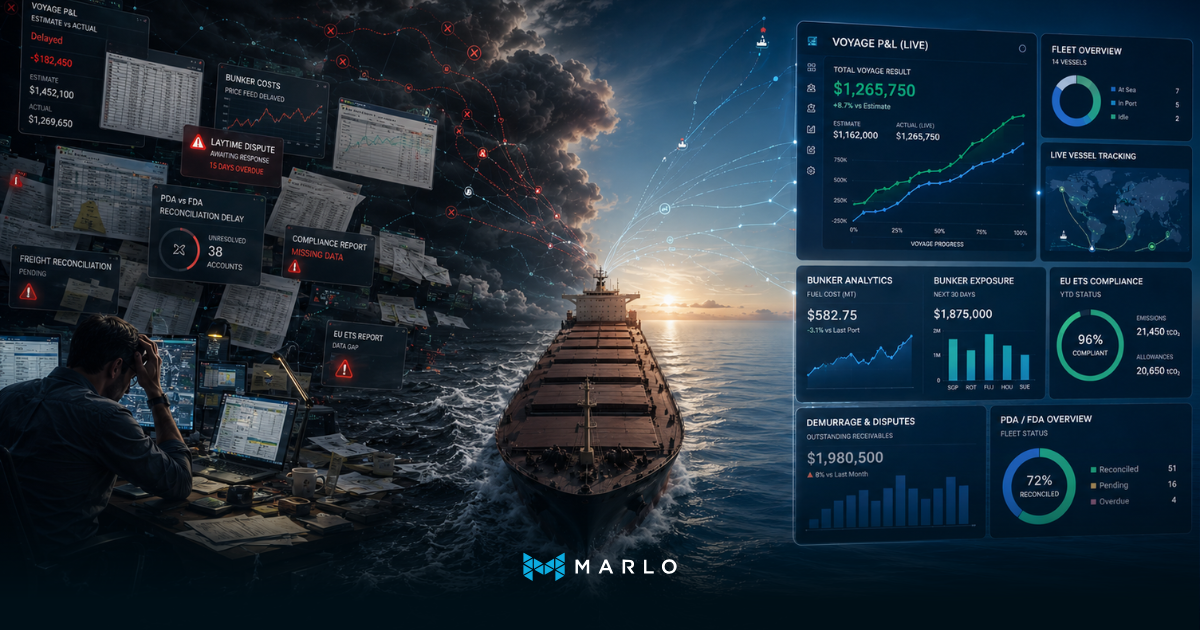
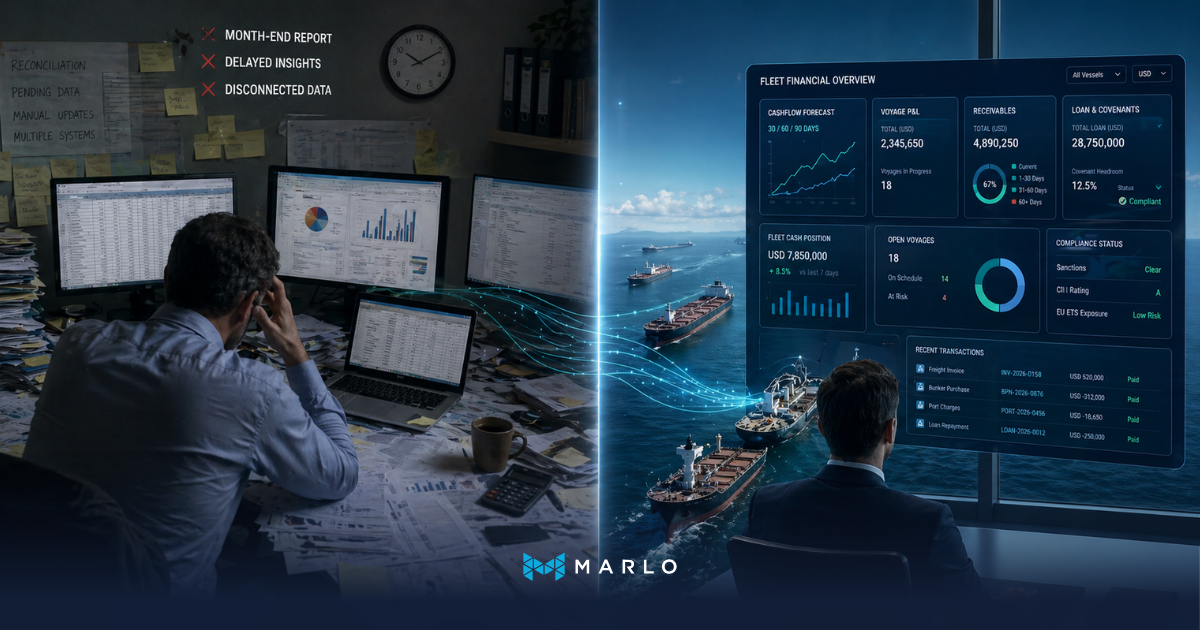
For CFOs and operations managers at dry bulk shipping companies, accurate voyage P&L calculation isn't just an accounting exercise; it's the foundation of profitable decision-making. Every fixture negotiation, route selection, and operational choice ultimately depends on understanding whether a voyage will generate profit or loss. Yet many operators struggle with voyage P&L accuracy, leading to poor commercial decisions, cash flow surprises, and missed opportunities.
This comprehensive guide walks you through the precise methodology for calculating voyage profit and loss, common pitfalls to avoid, and how modern software solutions are transforming this critical process.
Why Accurate Voyage P&L Matters
Before diving into calculations, let's establish why getting voyage P&L right is mission-critical for dry bulk operators.
The Decision-Making Impact
Every commercial decision in shipping relies on voyage economics. When chartering managers evaluate a cargo offer, they need to know: Will this voyage generate acceptable returns? How does it compare to alternative employment? Should we position ballast to capture a better fixture, or take the cargo that's available now?
Inaccurate voyage estimates lead to accepting unprofitable business, rejecting good opportunities, or making suboptimal routing decisions. A miscalculation that underestimates costs by just 10% can transform an apparently profitable voyage into a loss-maker.
Cash Flow Management
For mid-sized operators with 5-50 vessels, working capital management is perpetually tight. Voyage P&L directly drives cash flow forecasting. If your estimates show a $50,000 profit but the actual result is a $20,000 loss, that $70,000 variance multiplied across multiple concurrent voyages can create serious liquidity problems.
Understanding voyage economics also helps negotiate better payment terms with charterers and plan for upcoming capital requirements like bunker purchases or port disbursements.
Performance Benchmarking
Accurate voyage P&L enables meaningful performance analysis. Which routes consistently deliver better returns? Which vessels outperform fleet averages? Are certain charterers more profitable to work with? Without reliable voyage-level financial data, these critical questions remain unanswered.
Step 1: Calculate Voyage Revenue
Voyage revenue forms the income side of your P&L equation. For voyage charters in the dry bulk sector, this calculation appears straightforward but contains important nuances.
Gross Freight Calculation
The fundamental revenue calculation starts with:
Gross Freight = Freight Rate × Cargo Quantity
For example, if you're carrying 50,000 metric tonnes of coal at $18 per tonne, your gross freight is $900,000.
However, freight rate structures vary. Rates may be quoted as dollars per metric tonne, lump sum for the entire voyage, or based on other units depending on the commodity and charter party terms. Always verify which unit applies to your specific fixture.
Additional Revenue Sources
Beyond basic freight, several other revenue streams can contribute to voyage income:
Demurrage Revenue: If the charterer exceeds the allowed laytime for loading or discharge operations, you earn demurrage at the agreed daily rate. This compensates you for the vessel being detained beyond the contracted time.
For example, if laytime is exceeded by 2.5 days and the demurrage rate is $25,000 per day, you would add $62,500 in demurrage revenue. Demurrage is calculated on a pro-rata basis, meaning partial days count proportionally.
Despatch Payments: Conversely, if the charterer completes cargo operations faster than the allowed laytime, they may earn despatch money. The despatch rate is typically half the demurrage rate—a common clause is "despatch half demurrage" (DHD or D½D).
If operations finish 1.5 days early with a despatch rate of $12,500 per day (half of a $25,000 demurrage rate), you would deduct $18,750 from your revenue as despatch owed to the charterer.
Deadfreight: If the charterer fails to load the agreed cargo quantity, they owe deadfreight on the shortage. This compensates you for the lost cargo space at the contracted freight rate.
Calculating Net Freight
Your net freight—the actual revenue you'll receive—requires deducting commissions from gross freight:
Net Freight = Gross Freight - Brokerage Commission - Address Commission
Step 2: Account for Commissions
Commissions reduce your revenue and must be accurately calculated. Two types of commissions typically apply in dry bulk voyage charters.
Brokerage Commission
Shipbrokers earn commission for arranging the charter party. The standard brokerage rate is 1.25% per broker. If multiple brokers are involved in a transaction, each typically receives 1.25% on the gross freight.
For our $900,000 gross freight example with two brokers involved:
- Total brokerage: $900,000 × 2.5% = $22,500
Brokerage is calculated on gross freight including any primage (an additional percentage on freight, though this is less common in modern charters).
Address Commission
Address commission compensates the charterer for their shipping department costs and typically ranges from 1.25% to 3.75% of gross freight, with 2.5% being common.
Using our example with 2.5% address commission:
- Address commission: $900,000 × 2.5% = $22,500
So total commissions of $45,000 ($22,500 + $22,500) would be deducted from the $900,000 gross freight, leaving net freight of $855,000.
Important Note: Commissions are calculated on freight earned, not necessarily freight agreed. If deadfreight or demurrage applies, these may also be subject to commission depending on charter party terms.
Step 3: Calculate Bunker (Fuel) Costs
Bunker costs represent one of the largest and most variable voyage expenses, typically accounting for 25-50% of total voyage costs. Accuracy here is critical.
Understanding Fuel Types
Modern vessels primarily use:
- VLSFO (Very Low Sulphur Fuel Oil) - 0.5% sulphur content, compliant with IMO 2020 regulations for main engine fuel
-
- MGO (Marine Gas Oil) - Used in auxiliary engines and sometimes in emissions control areas
-
- ULSFO (Ultra Low Sulphur Fuel Oil) - 0.1% sulphur content for certain emissions control areas
Fuel Consumption Calculation
Calculate bunker requirements based on:
- Sea passage consumption: Speed and consumption at sea for the main engine and auxiliaries
-
- Port consumption: Fuel used during cargo operations, typically lower than at sea
- Canal transit consumption: Often uses MGO and at reduced speeds
Example Calculation:
Consider a Panamax vessel with these consumption rates:
- At sea: 25 tonnes VLSFO per day + 1.5 tonnes MGO per day
- In port: 2 tonnes MGO per day
- Voyage distance: 8,500 nautical miles at 13 knots = 27.2 days at sea
- Port time (loading + discharge): 6 days total
Sea passage fuel:
- VLSFO: 27.2 days × 25 tonnes = 680 tonnes
- MGO: 27.2 days × 1.5 tonnes = 40.8 tonnes
Port fuel:
- MGO: 6 days × 2 tonnes = 12 tonnes
Total consumption: 680 tonnes VLSFO + 52.8 tonnes MGO
Bunker Pricing
Multiply consumption by current bunker prices. Prices vary significantly by port and change daily, so use prices relevant to your planned bunkering locations.
At assumed prices of $550/tonne VLSFO and $650/tonne MGO:
- VLSFO cost: 680 tonnes × $550 = $374,000
- MGO cost: 52.8 tonnes × $650 = $34,320
- Total bunker cost: $408,320
Bunker Planning Considerations
Don't forget to account for:
- Bunkers on board (ROB): The fuel already on the vessel at voyage start
-
- Safety margin: Additional fuel for weather delays or route deviations (typically 5-10% sea margin)
-
- Price volatility: Bunker prices can change significantly between estimate and actual bunkering
Step 4: Account for Port Costs and Dues
Port expenses vary widely by location, cargo type, and vessel size. These costs must be estimated for both loading and discharge ports.
Port Disbursement Components
Port costs typically include:
Pilotage: Fees for pilots who guide the vessel in and out of port, based on vessel size and draft
Towage: Tug boat assistance for berthing and unberthing operations
Port Dues: Charges for using port facilities, calculated on gross tonnage or cargo quantity
Agency Fees: Local port agent fees for coordinating the port call and handling documentation
Cargo-Related Charges: May include wharfage, berth hire, or terminal handling charges depending on charter party terms
Fresh Water: If bunkering fresh water for the vessel
Miscellaneous: Garbage disposal, customs clearance, security charges, health inspections
Obtaining Accurate Estimates
For accurate port cost estimates:
- Contact port agents directly for proforma disbursement accounts (PDAs)
- Use historical data from similar previous calls
- Factor in vessel-specific characteristics (LOA, GRT, draft, DWT)
- Confirm which party bears various costs under the charter party terms (FIO, FIOS, liner terms, etc.)
Example Port Costs
For a typical Panamax dry bulk vessel:
Loading Port (e.g., Richards Bay, South Africa):
- Pilotage: $4,500
- Towage: $8,000
- Port dues: $12,000
- Agency fees: $3,500
- Miscellaneous: $2,000
- Total loading port: $30,000
Discharge Port (e.g., Rotterdam, Netherlands):
- Pilotage: $6,000
- Towage: $10,000
- Port dues: $15,000
- Agency fees: $4,000
- Miscellaneous: $2,500
- Total discharge port: $37,500
Combined port costs: $67,500
Step 5: Include Canal and Waterway Fees
If your voyage route includes major canals or waterways, these fees can be substantial and must be factored into voyage economics.
Suez Canal
Suez Canal tolls are calculated based on the Suez Canal Net Tonnage (SCNT) and whether the vessel transits laden or in ballast. For dry bulk vessels, laden transit costs significantly more than ballast.
A typical Panamax bulk carrier (around 75,000 DWT) might pay $250,000-$350,000 for a laden transit through Suez, depending on specific SCNT calculation and current tariff rates.
Panama Canal
Panama Canal tolls for the Neopanamax locks are based on vessel type, size (PC/UMS tons), and whether laden or ballast. A laden dry bulk vessel transit might cost $150,000-$300,000 depending on vessel specifications.
Other Waterways
Don't overlook smaller but still significant waterway fees:
- Turkish Straits (Bosphorus/Dardanelles): Relatively modest fees but still several thousand dollars
- Kiel Canal: Fees based on vessel size
- St. Lawrence Seaway: Tolls for Great Lakes access
Example Canal Cost
For our example voyage, if the route requires Suez Canal transit:
Suez Canal (laden northbound): $280,000
This single line item can dramatically impact voyage profitability, which is why route selection (via Suez vs. Cape of Good Hope, or via Panama vs. around Cape Horn) is a critical commercial decision that depends on accurate voyage P&L calculation.
Step 6: Calculate Laytime and Demurrage/Despatch
Laytime calculations significantly impact final voyage P&L and are a frequent source of disputes and errors.
Understanding Laytime Terms
Laytime is the period agreed between owner and charterer for loading and discharging cargo operations. Common terms include:
SHEX: Sundays and Holidays Excluded - cargo operations pause on these days SHINC: Sundays and Holidays Included - cargo operations continue through weekends and holidays Weather Working Days (WWD): Only days with suitable weather count Running Days: All days count continuously regardless of weather or holidays
Demurrage Calculation
If actual cargo operations exceed allowed laytime, the vessel is "on demurrage" and the charterer owes the owner compensation.
Example:
- Allowed laytime: 72 hours (3 days)
- Actual time used: 96 hours (4 days)
- Excess time: 24 hours (1 day)
- Demurrage rate: $25,000 per day
- Demurrage earned: $25,000
The phrase "once on demurrage, always on demurrage" means that typical laytime exceptions (like weekends or holidays) generally don't apply during demurrage unless explicitly stated in the charter party.
Despatch Calculation
If operations complete faster than allowed laytime, the owner owes despatch to the charterer:
Example:
- Allowed laytime: 72 hours (3 days)
- Actual time used: 60 hours (2.5 days)
- Time saved: 12 hours (0.5 days)
- Despatch rate: $12,500 per day (half demurrage)
- Despatch owed: $6,250
Laytime Calculation Complexity
Accurate laytime calculation requires:
- Determining when laytime commences (typically after Notice of Readiness is tendered and accepted)
- Tracking interruptions and exceptions per charter party terms
- Accounting for weather delays, port congestion, or vessel issues
- Maintaining detailed Statement of Facts documentation
- Understanding whether laytime is "reversible" (loading and discharge pooled together)
Many disputes arise from differing interpretations of laytime terms, making this one of the most legally complex aspects of voyage accounting.
Step 7: Add Remaining Voyage Expenses
Several additional costs round out the complete voyage P&L calculation.
Cargo-Related Costs
Depending on charter party terms, you may incur:
- Stevedoring costs: Loading and discharge labor and equipment if not on charterer's account
-
- Cargo securing: Lashing, dunnage, or other cargo protection
-
- Extra insurance: War risk insurance for certain trading areas, or additional hull insurance for high-risk cargoes
Time-Related Costs
- Daily running costs: Crew wages, provisions, maintenance, lubricants, insurance allocated to voyage duration
- Off-hire deductions: If vessel was off-hire during the voyage, these costs typically don't generate revenue recovery
Financial Costs
- Bunker financing charges: If borrowing to finance bunker purchases
- Foreign exchange losses: If freight is in one currency and expenses in another
- Bank charges: Wire transfer fees and similar transaction costs
Example Additional Costs
For our example voyage:
- Daily running costs: $6,000/day × 33 days total = $198,000
- War risk insurance (transit Red Sea): $15,000
- Extra bunker for weather deviation: $8,000
- Total additional costs: $221,000
Step 8: Calculate Final Voyage Result
Now we can assemble all components into the complete voyage P&L:
Revenue Summary
- Gross freight: $900,000
- Less: Brokerage (2.5%): ($22,500)
- Less: Address commission (2.5%): ($22,500)
- Add: Demurrage: $25,000
- Net voyage revenue: $880,000
Expense Summary
- Bunker costs: $408,320
- Port costs (loading): $30,000
- Port costs (discharge): $37,500
- Suez Canal: $280,000
- Daily running costs: $198,000
- Extra expenses: $23,000
- Total voyage expenses: $976,820
Net Voyage Result
Net voyage profit/(loss): ($96,820)
This voyage would result in a loss of nearly $97,000—a critical finding that should lead to rejecting the cargo, negotiating better freight terms, or finding route alternatives.
Daily Performance Metrics
Beyond absolute profit/loss, calculate performance metrics:
Time Charter Equivalent (TCE) = (Net revenue - Voyage expenses) / Voyage days
Using our example:
- Net revenue less voyage expenses (excluding time costs): ($96,820) + $198,000 = $101,180
- Voyage days: 33 days
- TCE: $3,066 per day
A TCE of $3,066/day for a Panamax vessel in 2026 would be unacceptably low, further confirming this voyage should be declined unless terms improve substantially.
Common Errors and How to Avoid Them
Even experienced operators make voyage P&L mistakes. Here are the most frequent errors and mitigation strategies.
Error 1: Incorrect Bunker Consumption Estimates
The Problem: Using outdated consumption figures or failing to account for weather, currents, or speed variations.
Impact: Bunker costs can vary by 20-30% from estimates, eliminating expected profit margins entirely.
Solution:
- Maintain updated vessel-specific consumption curves based on actual performance data
- Add 5-10% sea margin for adverse weather
- Use performance monitoring systems that track actual vs. planned consumption
- Account for fouling, engine degradation, and seasonal weather patterns
Error 2: Overlooked Port Cost Items
The Problem: Missing or underestimating port disbursement charges, especially miscellaneous fees.
Impact: Port costs can exceed estimates by $10,000-$30,000 per port call.
Solution:
- Always request proforma disbursement accounts from local agents
- Include contingency of 10-15% on agent estimates
- Verify which party (owner or charterer) bears specific charges under charter party terms
- Track actual vs. estimated port costs to improve future estimates
Error 3: Laytime Miscalculations
The Problem: Incorrect interpretation of laytime terms, missing exceptions, or arithmetic errors.
Impact: Demurrage disputes averaging $50,000-$150,000 are common in dry bulk shipping.
Solution:
- Carefully read charter party laytime clauses
- Use specialized laytime calculation software
- Maintain detailed Statements of Facts with timestamps
- Have legal review of non-standard laytime terms before fixing
- Train operations staff on proper laytime accounting
Error 4: Commission Calculation Mistakes
The Problem: Applying incorrect commission percentages or calculating on wrong base amounts.
Impact: Overpaying or underpaying commissions by thousands of dollars, creating disputes or financial losses.
Solution:
- Confirm exact commission terms in each charter party fixture recap
- Remember that address commission and brokerage often apply to demurrage as well as freight
- Use automated systems that apply correct commission rates consistently
Error 5: Exchange Rate Oversights
The Problem: Failing to account for currency conversion when freight is in one currency and costs in another.
Impact: Exchange rate movements can swing voyage results by 3-5% or more.
Solution:
- Lock in exchange rates at time of voyage estimate
- Use forward contracts or hedging for large exposures
- Track exchange rate changes between estimate and actual settlement
- Factor in bank conversion charges and spreads
Error 6: Incomplete Route Planning
The Problem: Not considering alternative routes or failing to account for all costs on chosen route.
Impact: Missing opportunities for $50,000-$200,000 in savings through different routing.
Solution:
- Compare multiple route options (via Suez vs. Cape, different bunkering ports)
- Account for all canal fees, additional bunker consumption, and time differences
- Consider geopolitical risks and insurance implications
- Use voyage optimization software for route comparison
Error 7: Ignoring Cargo Quantity Variations
The Problem: Assuming exact cargo quantity when actual intake depends on draft, trim, and loading conditions.
Impact: Revenue variations of $10,000-$50,000 from deadweight cargo calculations.
Solution:
- Calculate realistic cargo intake based on vessel particulars, load-line zones, and port restrictions
- Consider seasonal weather affecting load drafts
- Understand stowage factors for specific commodities
- Account for constant weights (fuel, stores, ballast water)
Error 8: Time Cost Allocation Errors
The Problem: Incorrectly allocating fixed daily running costs or miscalculating voyage duration.
Impact: TCE calculations off by $1,000-$3,000 per day affecting employment decisions.
Solution:
- Track actual voyage durations and compare to estimates
- Include waiting time, off-hire, and unexpected delays
- Allocate daily costs consistently across all voyage estimates
- Separate voyage costs from period costs for accurate comparisons
How Software Automates This Process
Manual voyage P&L calculation using spreadsheets is time-consuming, error-prone, and difficult to maintain across multiple concurrent voyages. Modern voyage management software transforms this process.
Automated Data Integration
Purpose-built voyage management systems pull data automatically from multiple sources:
- Bunker prices update daily from market feeds for all major bunkering ports
- Port costs integrate from agent databases or historical actuals
- Vessel performance draws from noon reports and AIS tracking
- Market rates feed from freight indices and broker networks
- Exchange rates update in real-time from financial data providers
This eliminates manual data entry and ensures estimates use current information.
Real-Time P&L Visibility
Rather than waiting weeks after voyage completion to understand profitability, modern systems provide:
- Continuous P&L updates as actual costs post and revenue gets invoiced
- Variance analysis comparing estimated vs. actual performance
- Alert triggers when costs exceed thresholds or margins compress
- Dashboard views showing P&L across entire fleet simultaneously
CFOs gain unprecedented visibility into voyage economics, enabling proactive intervention when voyages deviate from plan.
Scenario Comparison
Software enables rapid "what-if" analysis:
- Compare different cargo offers side-by-side
- Evaluate alternative routing options
- Model impact of bunker price changes
- Test different loading/discharge rate assumptions
- Assess effect of demurrage risk on expected returns
This supports better commercial decision-making under tight time pressure.
Compliance and Documentation
Voyage management systems maintain:
- Complete audit trails of estimate changes and approvals
- Standardized calculation methodologies across the organization
- Integration with accounting systems for seamless financial reporting
- Archived voyage data for performance benchmarking and legal disputes
Laytime Automation
Advanced systems include specialized laytime calculators that:
- Apply charter party terms automatically
- Track events from Statement of Facts
- Calculate demurrage/despatch per contract
- Generate time sheets and supporting documentation
- Manage laytime claims through settlement
How Marlo Simplifies Voyage P&L Management
For dry bulk operators managing 5-50 vessels, Marlo provides an integrated platform that transforms voyage P&L from a manual, time-consuming process into an automated, real-time decision-support tool.
Automated Voyage Estimation
Marlo's voyage calculator pulls together all cost and revenue elements in a single interface:
- Pre-populated vessel consumption profiles based on historical performance
- Live bunker pricing for multiple bunkering ports
- Port cost databases with agent proforma integrations
- Canal fee calculators for major waterways
- Automatic commission calculations per fixture terms
Chartering managers can evaluate cargo opportunities in minutes rather than hours, comparing multiple scenarios before committing to fixtures.
Real-Time P&L Tracking
Once a voyage is fixed, Marlo continuously updates the P&L as:
- Actual port expenses post from agent invoices
- Fuel consumption reports come in from vessel noon reports
- Demurrage or despatch crystallizes during cargo operations
- Freight invoices process and payments collect
CFOs see current voyage results across the entire fleet on a single dashboard, with variance analysis highlighting which voyages are outperforming or underperforming estimates.
Intelligent Cost Management
Marlo helps control voyage expenses through:
- Budget alerts when estimated costs are exceeded
- Invoice matching against estimates to catch discrepancies
- Automatic reconciliation of agent disbursements
- Centralized approval workflows for voyage expenses
Financial Integration
Voyage P&L data flows seamlessly into your accounting system:
- Automated journal entries for voyage revenue and expenses
- Cash flow forecasting based on voyage projections
- Integration with accounts payable and receivable
- Financial reporting at voyage, vessel, or fleet level
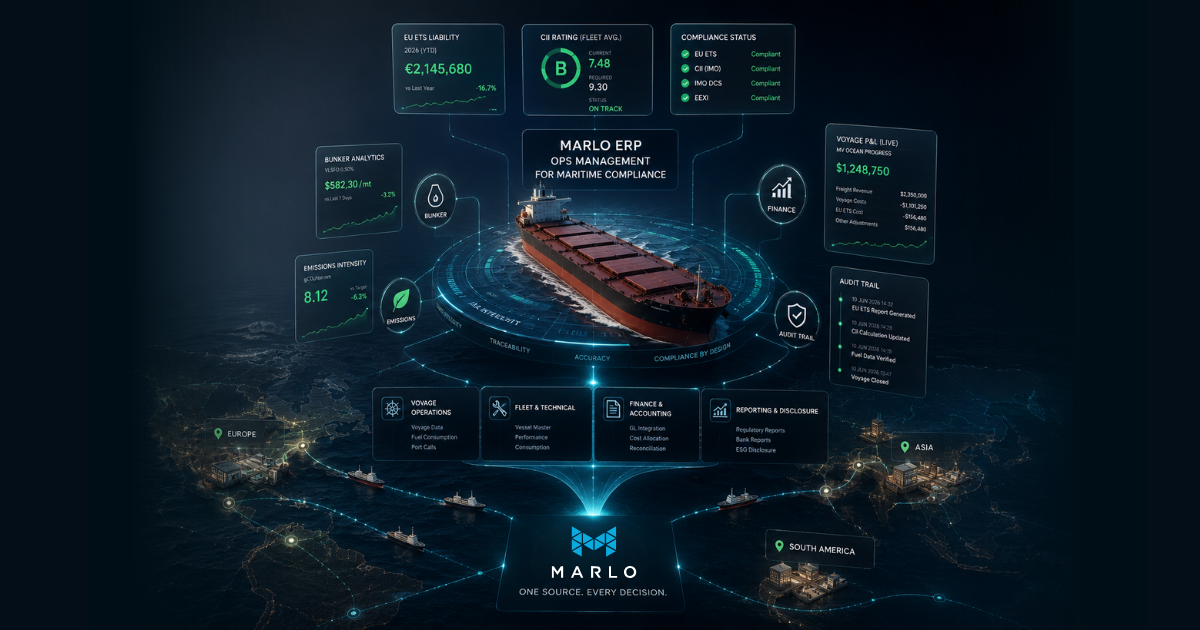
Compliance Module
As regulations like EU ETS and FuelEU Maritime introduce carbon costs into voyage economics, Marlo's compliance module automatically:
- Calculates carbon costs per voyage based on route and fuel consumption
- Factors regulatory compliance costs into voyage estimates
- Tracks compliance obligations across the fleet
- Generates required regulatory reports
This ensures voyage P&L reflects the true total cost including environmental compliance, critical for accurate decision-making in 2026's regulatory environment.
Get Started with Accurate Voyage P&L
Accurate voyage P&L calculation is fundamental to profitable dry bulk operations. By following the step-by-step methodology in this guide, avoiding common errors, and leveraging modern software automation, you can transform voyage economics from a backward-looking accounting exercise into a forward-looking decision support capability.
Key Takeaways
-
Voyage P&L accuracy drives commercial success: Every fixture decision, route choice, and operational trade-off depends on reliable voyage economics
-
Detail matters: Small errors in bunker estimates, port costs, or commission calculations compound across multiple voyages to create significant financial impact
-
Laytime is complex: Demurrage and despatch calculations require careful attention to charter party terms and detailed documentation
-
Manual processes don't scale: Spreadsheet-based voyage estimation becomes unmanageable beyond a handful of vessels and creates substantial error risk
-
Real-time visibility changes the game: Moving from post-voyage analysis to continuous P&L monitoring enables proactive management and better outcomes
-
Integration amplifies value: Connecting voyage P&L to accounting, compliance, and operations systems creates a single source of truth
Try Marlo's Automated Voyage P&L Calculator Free for 30 Days
Ready to eliminate manual voyage calculations and gain real-time visibility into your fleet's profitability?
Marlo's integrated voyage management platform provides:
✓ Automated voyage P&L calculation with live market data
✓ Real-time tracking of actual vs. estimated performance
✓ Scenario comparison for multiple cargo opportunities
✓ Laytime and demurrage/despatch management
✓ Compliance cost integration (EU ETS, FuelEU)
✓ Financial system integration for seamless accounting
Start Your Free 30-Day Trial →
Join dry bulk operators who have reduced voyage estimation time by 75% while improving accuracy and decision-making with Marlo's purpose-built voyage management solution.
About Marlo: Marlo provides integrated software solutions for dry bulk shipping companies, combining voyage management, compliance tracking, and financial operations in a single platform designed specifically for the maritime industry. Learn more at www.marlo.co

-1.png) Alex
Alex
-1.png?width=30&name=Untitled%20design%20(98)-1.png) Alex: Jun 19, 2026
Alex: Jun 19, 2026