The Problem: Discovering Violations After the Bank Blocks Payment
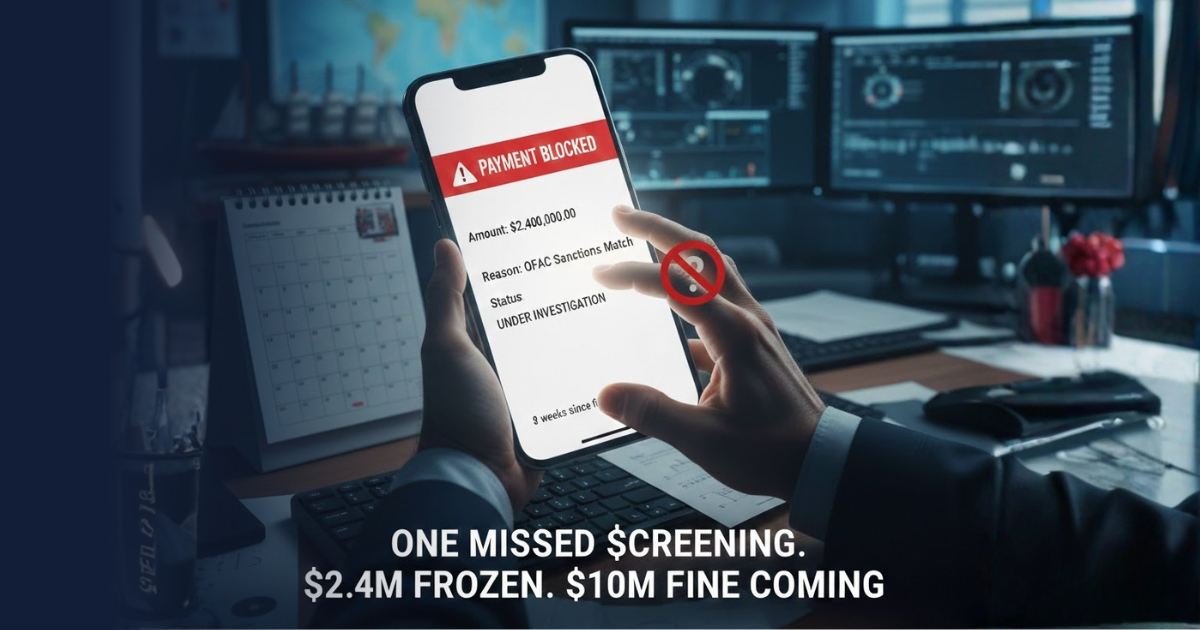
Your bank calls Friday afternoon: "We've frozen your $2.4M freight payment. Charterer is on OFAC's sanctions list."
Your immediate panic: We screened them before the fixture. How did this happen?
The answer: OFAC updated their list two weeks ago. Your quarterly compliance review missed it. The fixture closed three weeks ago. The voyage is complete.
The damage:
Regulatory investigation: OFAC enforcement action likely
Potential fine: $10M-$50M per violation (recent maritime penalties)
Bank relationship: Account frozen, enhanced monitoring required
Lender default: Sanctions violation triggers cross-default across loan facilities
Reputational damage: Public disclosure, difficulty securing future charters
CFO accountability: Board questions compliance procedures, potential termination
This is the maritime CFO's sanctions nightmare. One missed screening check, discovered too late, ends careers.
Why Manual Sanctions Screening Fails
The Quarterly Check Problem
Maritime operators typically screen counterparties quarterly or before major fixtures. OFAC/EU/UN sanctions lists update weekly. A company clean on Monday can be sanctioned by Friday—but you won't know until next quarter's compliance review.
Example gap: Charter party signed January 15. Charterer added to OFAC list January 28. Quarterly screening scheduled for March 31. Discover violation 10 weeks late during Q1 review—after multiple freight payments processed.
The Manual Screening Bottleneck
Compliance officers manually check:
OFAC SDN List (13,000+ entities)
EU Consolidated Sanctions List (2,000+ entities)
UN Security Council Sanctions (800+ entities)
UK HM Treasury List (1,500+ entities)
Per fixture screening time: 45-90 minutes (charterer, vessel owner, beneficial owners, cargo shipper, port agents)
Result: Screening becomes bottleneck. Commercial teams pressure compliance to "speed it up." Shortcuts happen. Violations occur.
The Beneficial Ownership Blindness
Sanctioned entities hide behind shell companies, nominees, and complex ownership structures. Surface-level screening checks company name—misses that beneficial owner is sanctioned individual.
Real scenario: Charter with "ABC Maritime Ltd" (clean). Beneficial owner is sanctioned individual operating through 3-layer corporate structure. Manual screening misses connection. OFAC doesn't care—you're liable.
The Vessel Tracking Gap
Your chartered vessel enters Iranian waters for transshipment. You discover this during monthly operations review—3 weeks after port call. Bank questions payment. OFAC investigates. Too late to prevent.
The Solution: Automated Real-Time Sanctions Monitoring
Pre-Fixture Automated Screening
Before charter party signature, system automatically screens:
Charterer entity name + beneficial owners
Vessel IMO number + registered owner
Cargo shipper/receiver entities
Port agents and service providers
All against OFAC/EU/UN/UK lists simultaneously
Screening time: 30 seconds (vs. 60 minutes manual)Coverage: 100% of fixtures screened (vs. selective manual review)Accuracy: API-direct from official sanctions databases (vs. manual list checking)
Continuous Monitoring & Automatic Rescreening
When OFAC updates lists (weekly), system automatically rescreens all active counterparties in database.
Example: Monday update adds 47 entities to OFAC list. By Tuesday morning, system has rescreened your 847 active counterparties, flagging 2 matches requiring immediate action. Discover violations within 24 hours of list update, not 60 days later.
Real-Time Vessel Tracking with Zone Alerts
Integrated AIS monitoring tracks chartered vessels continuously. Automated alerts when vessels:
Enter sanctioned zones (Iran, Syria, North Korea waters)
Conduct ship-to-ship transfers in high-risk areas
Turn off AIS ("going dark"—sanctions evasion indicator)
Call at restricted ports
CFO benefit: Know immediately—not during monthly review—when chartered vessels engage in sanctions-risk activity.
Beneficial Ownership Screening
System screens beyond surface-level company names, checking:
Ultimate beneficial owners (UBO)
Directors and officers
Parent companies and subsidiaries
Known aliases and former names
Politically exposed persons (PEP)
Detects: Sanctioned individuals hiding behind corporate structures that manual screening misses.
Integrated Compliance Workflow
Sanctions screening embedded in chartering process:
Commercial enters charter party details
System auto-screens all parties
Fixture cannot be confirmed until compliance clears
If flagged, compliance review required before proceeding
All screening history logged for audit trail
Result: No fixtures slip through without sanctions clearance. Compliance becomes gatekeeper, not post-facto reviewer.
Real-World Impact
Time Savings: Screening time per fixture: 60 minutes → 30 seconds. For 240 annual fixtures: 240 hours → 2 hours saved.
Violation Prevention: Continuous monitoring catches list updates within 24 hours vs. 60-day quarterly review gap. Estimated violations prevented annually: 2-4 (each potentially $10M+ fine).
Bank Relationship Protection: Zero frozen payments from sanctions violations vs. 1-2 annual incidents requiring remediation and enhanced monitoring.
Lender Confidence: Automated compliance screening satisfies lender covenant requirements for sanctions monitoring, avoiding potential covenant breach from compliance failures.
Audit Trail: Complete screening documentation for every counterparty, every vessel, every fixture—exportable for bank due diligence, P&I Club requirements, and regulatory audits.
ROI: The Avoidance Calculation
Single OFAC violation cost:
Regulatory fine (minimum): $10M
Legal defense: $500K-$2M
Enhanced compliance program: $300K-$500K annually
Reputational/business loss: Unquantifiable
Total minimum cost: $11M-$13M
Automated sanctions monitoring cost:
- Implementation: $30K-$40K
- Annual subscription: $20K-$30K (integrated with maritime ERP)
- Year 1 total: $50K-$70K
ROI from preventing ONE violation: 150-250x
Even valuing prevention at 5% probability annually: Expected value of prevention = $550K-$650K vs. $50K-$70K cost = 8-12x annual ROI
Implementation: 4-Week Timeline
Week 1: Configure sanctions list API connections (OFAC, EU, UN, UK)Week 2: Import existing counterparty database, run historical screeningWeek 3: Integrate with chartering workflow, configure alert rulesWeek 4: User training, go-live with automated screening
Post-implementation: Daily automated rescreening, immediate alerts on new list additions.
Conclusion: Sanctions Risk is CFO Risk
Maritime CFOs are personally accountable for sanctions compliance. Manual quarterly screening is structurally insufficient in an environment where sanctions lists update weekly and enforcement penalties exceed $10M per violation.
Automated real-time sanctions monitoring is no longer optional—it's regulatory survival.
Technology exists. Implementation: 4 weeks. Cost: $50K-$70K Year 1. Value of preventing one violation: $10M-$13M.
When do you implement?
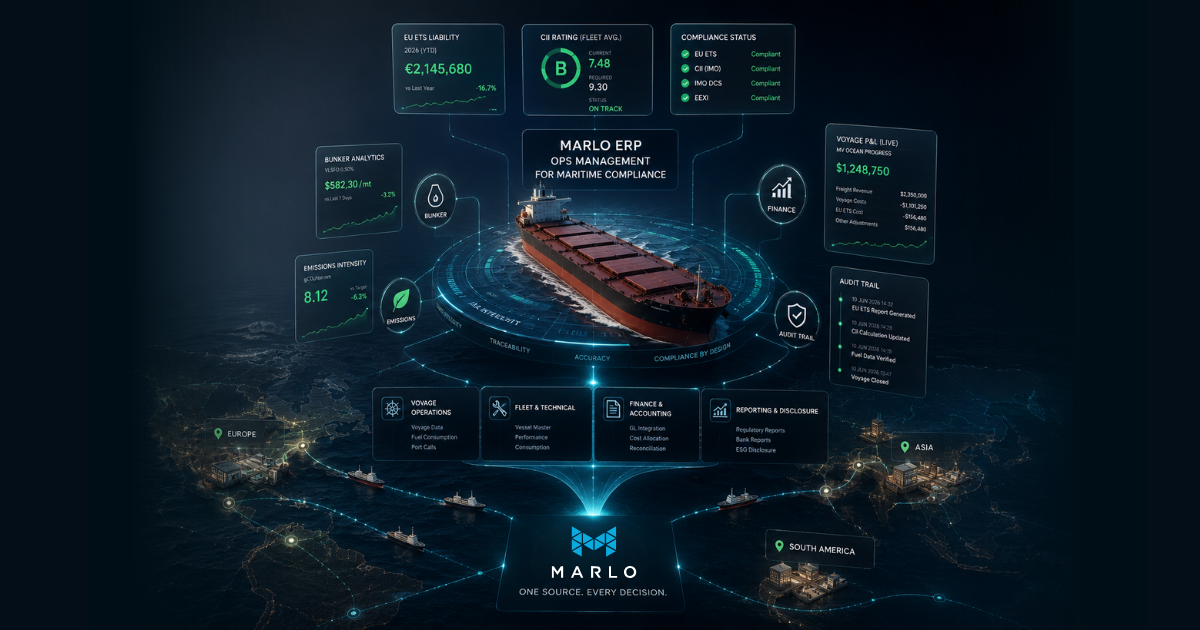
Marlo (www.marlo.co): Integrated maritime ERP with automated OFAC/EU/UN sanctions screening for dry bulk/tanker operators.
Features: Pre-fixture screening, continuous monitoring, vessel tracking, beneficial ownership checks, integrated compliance workflow, audit-ready documentation.
Try Marlo for free
Sanctions compliance requirements vary by jurisdiction. Consult legal counsel for regulatory obligations.

-1.png) Alex
Alex
-1.png?width=30&name=Untitled%20design%20(98)-1.png) Alex: Jun 19, 2026
Alex: Jun 19, 2026